Sunday, December 31, 2006

A Wonderful Time of Prayer

Our congregation is currently having a time of 24 hour prayer at our church. We believe that God opened a door for us to do this a little over a month ago when two members of our prayer group, independent of each other's knowledge, presented a case for 24 hour prayer at our church and did so within a few hours of each other.

As I write this, we are in the tenth hour of prayer and the last hour of the year 2006. This has been and continues to be a blessed time as we reflect on the past year and pray for a spirit of repentance on the individual, family, congregational and national church level. Our pastor today preached in conjunction with our vigil of prayer. He preached on Ephesians 3:14-21 and presented Paul's (and Christ's) grand vision of what the church can and should be. It is my last prayer of the year 2006.

For this reason I kneel before the Father, from whom his whole family in heaven and on earth derives its name. I pray that out of his glorious riches he may strengthen you with power through his Spirit in your inner being, so that Christ may dwell in your hearts through faith. And I pray that you, being rooted and established in love, may have power, together with all the saints, to grasp how wide and long and high and deep is the love of Christ, and to know this love that surpasses knowledge—that you may be filled to the measure of all the fullness of God. Now to him who is able to do immeasurably more than all we ask or imagine, according to his power that is at work within us, to him be glory in the church and in Christ Jesus throughout all generations, for ever and ever! Amen.

Thank you Lord Jesus for 2006. Be with us in the year 2007, the year of grace.


Monday, December 25, 2006

Merry Christmas

In your prayers today, ponder the wonder of God fully manifest in Jesus Christ. True God. True Man. Enough to keep theologians busy for millennia. Profound enough to move us and inspire our prayers for eternity.

To all the readers of this blog, a blessed and Merry Christmas from the School of the Solitary Place!!!

Oh, by the way, the answer to the puzzle. The lockers which are perfect squares remain open (1,4,9,16,...961)

Monday, December 18, 2006

And now for something completely different...


This blog usually contains reflections on personal prayer. However, during this Christmas season, I want to do something completely different for this entry. I'm posting a puzzle.

For the last few years, we have included a Christmas puzzle with our family's Christmas newsletter. In this year's newsletter, I included the URL for this blog and asked our newsletter recipients to see the new blog. So, in this entry, I'm including a bonus Christmas puzzle (to try to make up for last year's newsletter, which, due to time commitments, never got sent out in time.

So, for family, friends and readers of this blog, the bonus puzzle follows:

Santa's 1000 elves each have their own individual locker. These lockers are found one next to each other in a very long corridor of Santa's workshop. All the lockers start out being closed. Elf #1 opens every locker. Elf#2 closes every second locker(i.e. Lockers 2,4,6,8,10,etc). Elf #3 changes the state of every third locker (i.e. if opened, he closes it; If it is closed, he opens it). Elf #4 changes the state of every fourth locker. Elf #5 changes the state of every fifth locker. Each following elf does the same (i.e. Elf "n" changes the state of every "n"th locker).

After Elf 1000 changes the state of Locker 1000, which lockers are open?

Please feel free to post your answers via the Comments. I will have the answer on the Christmas Day entry to this blog. Have fun with the puzzle. Merry Christmas!!!

Sunday, December 10, 2006

Some Thoughts on 24 Hour Prayer


Recently, my thoughts have been on 24/7 prayer. Our home church will be having a time of 24 continuous hours of prayer from New Year's Eve into New Year's Day. We are seeking this to be a time to look to God with a heart and mind toward repentance and seeking Him in love and in holiness, on the individual, family, congregational and national level.

In helping to prepare for this time, I have found an excellent brief summary of the history of 24 hour prayer which can be found here. It is a practice which takes our earthly practices and matches them to the heavenly. In the vision of heavenly worship which John saw as recorded in the Book of Revelation, we find:

At once I was in the Spirit, and there before me was a throne in heaven with someone sitting on it. And the one who sat there had the appearance of jasper and carnelian. A rainbow, resembling an emerald, encircled the throne. Surrounding the throne were twenty-four other thrones, and seated on them were twenty-four elders. They were dressed in white and had crowns of gold on their heads. From the throne came flashes of lightning, rumblings and peals of thunder. Before the throne, seven lamps were blazing. These are the seven spirits of God. Also before the throne there was what looked like a sea of glass, clear as crystal.

In the center, around the throne, were four living creatures, and they were covered with eyes, in front and in back. The first living creature was like a lion, the second was like an ox, the third had a face like a man, the fourth was like a flying eagle. Each of the four living creatures had six wings and was covered with eyes all around, even under his wings. Day and night they never stop saying: "Holy, holy, holy is the Lord God Almighty, who was, and is, and is to come." Whenever the living creatures give glory, honor and thanks to him who sits on the throne and who lives for ever and ever, the twenty-four elders fall down before him who sits on the throne, and worship him who lives for ever and ever. They lay their crowns before the throne and say: "You are worthy, our Lord and God, to receive glory and honor and power, for you created all things, and by your will they were created and have their being." (Revelation 4:2-11) Emphasis bolded.

The worship of God in heaven is happening non-stop. Those who have started 24/7 prayer in the past have tried to match this pattern.

One last point about this is that 24/7 prayer requires a community of believers. Even if each hour of a prayer watch is being prayed through with only one person per hour, it requires a community of believers to make this happen. It can present an opportunity for both solitary and corporate prayer.


Friday, December 1, 2006

Our Intercessor in Heaven

There are two seasons of the year when Christians will think through the historical events of the life of Christ on Earth. During the weekend of Maundy Thursday, Good Friday and Easter Sunday, our attention is drawn back to the core events of the Christian faith

This Sunday marks the start of the season of Advent as we think through the events surrounding the birth of Jesus over 2000 years ago.

During these seasons, we might imagine what it would have been like to be with the shepherds near Bethlehem as they beheld the unearthly (in the best sense) and heavenly sight of angels rejoicing the birth of Him who forever would link Deity to humanity as the God-Man. We might wonder what that child looked like. In our imagination, we might "fast-forward" over thirty years and ponder what it would have been like to watch Jesus teach, or to sit with Him at the Last Supper, or to watch His agonized prayer in the Garden of Gethsamene, His arrest, trial, torture and crucifixion. We can only imagine what Mary Magdelene beheld that following Sunday morning as her eyes were opened and she saw the resurrected Christ.

Perhaps we can imagine what it will be like when Christ one day returns to Earth. Pondering this has generated enormous thought and speculation in our own time (the "Left Behind" series of novels by Tim LaHaye and Jerry Jenkins are just one sign of this).


However, have you ever thought about what Jesus Christ is doing at this present moment? The thought really came home to me when I was praying in a chapel on the evening of Maundy Thursday back in 1999. In that chapel was a seven-candle candlestick. As I was looking at it, a passage from the book of Revelation was brought to mind which spoke of Christ as one: "like a son of man,"dressed in a robe reaching down to his feet and with a golden sash around his chest. His head and hair were white like wool, as white as snow, and his eyes were like blazing fire. His feet were like bronze glowing in a furnace, and his voice was like the sound of rushing waters. (Revelation 1:13-15 NIV) and one who walked among the seven golden lampstands (Revelation 2;1) John was seeing a present-day view of Christ in majestic heavenly glory as He was then at the time of the Book of Revelation, over six decades after Jesus walked the Earth with His first disciples.

On this first day of December in the year 2006, what is Christ doing, right now?

We know that His sacrifice for salvation is completed and though He is our great High Priest, the significance of His priesthood now is that His sacrifice is perfect, complete and finished, never to be repeated. (See Hebrews 10:10-14)

So, what is Christ doing right now? Among the things which the Bible tells us about Christ's activities in Heaven, we have one text which indicates that Christ continues a facet of His ministry which He learned on Earth. Once more, the writer of the letter to the Hebrews gives us a view of what Christ is doing at this moment: Now there have been many of those priests, since death prevented them from continuing in office; but because Jesus lives forever, he has a permanent priesthood. Therefore he is able to save completely those who come to God through him, because he always lives to intercede for them. ( Hebrews 7:23-25 NIV)

In Heaven, the Lord Jesus continues His role as an intercessor in prayer for His people. We have One who stands for us in our behalf before the Father. Some branches of Christianity have overlooked this fact. They will many times succumb to a human tendency to see Jesus as the Judge to be placated. One can easily make the case that this is true for one who is not fully entrusting her/his life to Christ. Equally, one can show that this is not the case for a true believer in Jesus. Rather than shying away from Him in prayer, He welcomes us and prays in our behalf.

Rather than going to a dead saint or a live one to intercede for us before God, the true believer in Christ knows that they may "then approach the throne of grace with confidence, so that we may receive mercy and find grace to help us in our time of need." (Hebrews 4:16 NIV). Who better to have praying for us, getting 24/7 access to the Father, than the Lord Jesus, who desires that we model Him in our devotion to prayer.

John recorded in his gospel, the last recorded prayer of Christ before His arrest. In all of His praying, Jesus did not forget us:

I pray also for those who will believe in me through their message, that all of them may be one, Father, just as you are in me and I am in you. May they also be in us so that the world may believe that you have sent me. (John 17:20-21 NIV)

Tuesday, November 28, 2006

The Prayer Book of the Church

In our life of prayer, it is natural that prayer should well up from within us and be expressed in our own words. It is a mark of the conversational aspect of prayer from us to our heavenly Father. Our experiences in prayer may be such that this is the only form of prayer which we have so far encountered.

Throughout Church history, there have been a number of pre-prepared prayers which have served the people of God in a variety of ways. Texts such as the Book of Common Prayer contain the words for prayers used in communion services, weddings, morning and evening prayer and a large number of other church ceremonies. In addition to these formal and typically corporate expressions of prayer, we do encounter times in which we know we should pray but do not know how to frame the words of our requests.

As such, the Church has used the biblical book of Psalms as a hymnbook and a prayer book. Within its texts are the heartfelt convictions of the people of God. They can give us words by which to pray when words. from ourselves, sound empty and hollow. We find the words of Psalm 22 and Psalm 31 on the lips of Jesus as He was dying on the cross. The first verse of Psalm 110 was a delight to Jesus as it pointed to Him by posing a conundrum for the religious leaders of the time. (King David wrote "The LORD said to my Lord.." LORD refers to God but who is this other Lord who is over the King?)

The Church has embraced the Psalms in a special way over its 2000 year history. Chanting the Psalms has been the mainstay of monastic expressions of worship for 1500 years. In the fourth century, Macrina, the sister of Gregory, bishop of Nyssa was noted for her use of the Psalter at different times in her daily schedule. It is telling that two of the biggest archaeological finds during the last 25 years that had to do with Christian religious practice were the unearthing of Psalters. In 1984, a 4th century Psalter was located at a gravesite in an Egyptian cemetery 85 miles south of Cairo. Earlier this year, a construction worker in Ireland found a Psalter in a bog. This Psalter is thought to date back to 800-1000 A.D.

When you don't have the words for prayer, whether it is a time of distress, grief, joy, perplexity or just wanting to praise God, be open to using one of the Psalms as your prayer. They have the distinction of being inspired by the Holy Spirit and reflecting the heart of their human authors. Join the chorus of the church who have used the Psalms to praise God from the 1st century right up to the 21st century and beyond.

Sing to the LORD a new song; sing to the LORD, all the earth.
Sing to the LORD, praise his name; proclaim his salvation day after day.
Declare his glory among the nations, his marvelous deeds among all peoples.
For great is the LORD and most worthy of praise; he is to be feared above all gods.
For all the gods of the nations are idols, but the LORD made the heavens.
Splendor and majesty are before him; strength and glory are in his sanctuary.
Ascribe to the LORD, O families of nations, ascribe to the LORD glory and strength.
Ascribe to the LORD the glory due his name; bring an offering and come into his courts.
Worship the LORD in the splendor of his holiness; tremble before him, all the earth.
Say among the nations, "The LORD reigns." The world is firmly established, it cannot be moved; he will judge the peoples with equity.
Let the heavens rejoice, let the earth be glad; let the sea resound, and all that is in it;
let the fields be jubilant, and everything in them. Then all the trees of the forest will sing for joy;
they will sing before the LORD, for he comes, he comes to judge the earth. He will judge the world in righteousness and the peoples in his truth.
Psalm 96 NIV

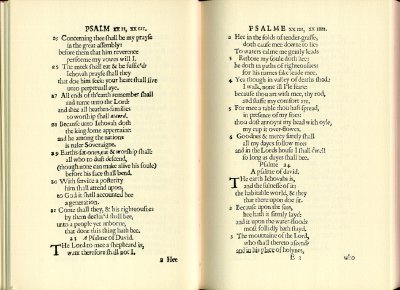
The photo above is of the Bay Psalm Book printed in 1640. It was the first book printed in colonial British America.

Thursday, November 23, 2006

A Day of Thanksgiving


Today is Thanksgiving Day in the United States.

In our nation's history, we look back to the 1620s in New England for the custom of setting aside a day for recognizing the blessings which God has given to us and to thank Him accordingly. Those festivals of thanks were typically preceded by days of fasting and humbling to seek God's favor and direction in difficult circumstances. Over the years, there were periodic celebrations of Thanksgiving, such as occurred in 1789 during the first year of George Washington's Presidency under our current Constitution. (The text of Washington's 1789 Thanksgiving proclamation can be found at: http://www.leaderu.com/humanities/washington-thanksgiving.html)

The concept of giving thanks to God is found throughout the Bible. (The Psalms are filled with praises of thanks to God). There is a dual sense to these biblical references to thankfulness. One sense is that of physical provision. We do know that all good gifts come to us from God. (See James 1:17). It is our duty to recognize that we are not the ultimate source of our physical well-being but God Himself. The second sense is that of the spiritual dimension. It is the recognition that God has done more than keep us warm and well-fed. For those who have faith in Christ, we are called to be those who are:

joyfully giving thanks to the Father, who has qualified you to share in the inheritance of the saints in the kingdom of light. For he has rescued us from the dominion of darkness and brought us into the kingdom of the Son he loves. Colossians 1:11-13 NIV

In the hustle and bustle of this day, please take the time to think about the blessings which you have received from God and be thankful for them. While this day is certainly a great time to express our gratitude to God, the Christian is called to show this attitude every day. It should be a part of our thinking and result in a life of gratitude. It must be a part of our life of prayer.

Thank you for reading this blog and being a part of the School of the Solitary Place.

Happy Thanksgiving!!!

Devote yourselves to prayer, being watchful and thankful. Colossians 4:2 NIV

Tuesday, November 21, 2006

An Interesting Meditation on Numbers 21


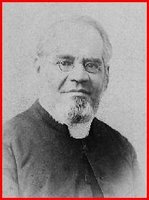
During the summer, while doing research for an article, I happened to find an autobiography of one of the individuals who preached in England during the revival which swept the British Isles in the late 1850s and early 1860s. From Death Into Life is the story of William Haslam (1818-1905), an English country parson who, in 1851, was converted during the preaching of a sermon on the topic of conversion. The unusual aspect of this is that the sermon was preached by William Haslam himself. The evidence of his changed heart and mind during that sermon was so obvious that a Methodist preacher in attendance at the service began to cry out "The Parson is converted!"

I wanted to include a brief section of Chapter 34 of the book as it is a meditation on the text of Numbers 21:5-9:

The people spoke against God and Moses, "Why have you brought us up out of Egypt to die in the wilderness? For there is no food and no water, and we loathe this miserable food." The LORD sent fiery serpents among the people and they bit the people, so that many people of Israel died. So the people came to Moses and said, "We have sinned, because we have spoken against the LORD and you; intercede with the LORD, that He may remove the serpents from us." And Moses interceded for the people. Then the LORD said to Moses, "Make a fiery serpent, and set it on a standard; and it shall come about, that everyone who is bitten, when he looks at it, he will live." And Moses made a bronze serpent and set it on the standard; and it came about, that if a serpent bit any man, when he looked to the bronze serpent, he lived.

Numbers 21:5-9 NASB

Recounting an incident just prior to his departure from Hayle, St. Johns, Haslam reflected:

A few weeks before leaving Hayle, as I was sitting by the fire one wet afternoon, my eyes fell on a little coloured picture on the mantle-piece, which had been the companion of my journeys for all the twenty years of which I have been writing. It was a quaint mediaeval illustration of Moses lifting up the serpent in the wilderness, copied from a valuable manuscript (Book of Prayers) in the Bodleian Library at Oxford.

As I looked at the engraving before me, I began to suspect for the first time that there was a design in the arrangement of the figures, and that it was really intended to convey some particular teaching. I took it in my hand and studied it, when I observed that the cross or pole on which the serpent was elevated stood in the centre, dividing two sets of characters, and that there were serpents on one side, and none on the other.

Behind the figure of Moses, is a man standing with his arms crossed on his breast, looking at the brazen serpent. He has evidently obtained life and healing by a look. On the other side, I observed that there were four kinds of persons represented, who were not doing as this healed one did to obtain deliverance.

First, there is one who is kneeling in front of the cross, but he is looking towards Moses, and not at the serpent, and apparently confessing to him as if he were a priest.

Next behind him is one lying on his back, as if he was perfectly safe,though he is evidently in the midst of danger; for a serpent may be seen at his ear, possibly whispering "Peace, peace, when there is no peace."

Still further back from the cross there is a man with a sad face doing a work of mercy, binding up the wounds of a fellow-sufferer, and little suspecting that he himself is involved in the same danger.

Behind them all, on the background, is a valiant man who is doing battle with the serpents, which may be seen rising against him in unabating persistency.

I observed that none of these men were looking at the brazen serpent as they were commanded to do. I cannot describe how excited and interested I became; for I saw in this illustration a picture of my own life. Here was the way of salvation clearly set forth, and four ways which are not the way of salvation, all of which I had tried and found unavailing. This was the silent but speaking testimony of some unknown denizen of a cloister, who lived in the beginning of the fifteenth century, in the days of ignorance and superstition. But not withstanding this darkness,he was brought out into the marvellous light of the Gospel, and has left this interesting record of his experience.

Like him, I also had fought with serpents, for I began in my own strength to combat with sin, and strove by my own resolutions to overcome. From this, I went on to do good works, and works of mercy, in the vain hope of thus obtaining the same for myself. Then, I relied in the Church for salvation, as God's appointed ark of safety; but not feeling secure, I took another step beyond, and sought forgiveness through the power of the priest. This I found was as ineffectual as all my previous efforts. At last, I was brought (by the Spirit of God) as a wounded and dying sinner, to look at the Crucified One. Then (as I have related), I found pardon and peace. Ever since it has been my joy and privilege (like Moses pointing to the serpent) to cry, "Behold the Lamb of God which taketh away the sin of the world" (John 1:29). "I have determined to know nothing but Jesus Christ and Him crucified;" that is, to tell only of the person and office of Jesus Christ our Lord.

As you may have guessed, the photograph above is that of William Haslam.

Saturday, November 18, 2006

The Link Between Prayer and Meditation

Recently, I have been re-reading "Spiritual Disciplines for the Christian Life" by Donald Whitney. It made a great impact on my Christian life when I first read it ten years ago. It contains a great number of reminders to develop our faith through biblically-based disciplines such as fasting, observing silence and solitude, journaling, etc. In my current re-reading, I have paid particular attention to his chapter on the discipline of prayer. The chapter is a good overview of the reasons and motivations for prayer. One apsect of prayer which Whitney covers and which I haven't seen covered elsewhere is the linkage between meditation and prayer.

First, some definitions are in order. In our multi-cultural and multi-religion society, we might think about meditation in its eastern religious sense in which meditation is the emptying of one's mind. My intended sense here is not the eastern religions' sense but one which follows a biblical pattern. It is the thoughtful pondering of Scripture. It is the process by which we think through the implications of biblical truths and how they apply to our lives.

Psalm 119 is the quintessential call to biblical meditation. Being the longest chapter of the Bible with 176 verses, it explicitly calls us to meditate in six separate verses:

Verse 15: I will meditate on Your precepts And regard Your ways.

Verse 23:Even though princes sit and talk against me, Your servant meditates on Your statutes.

Verse 27: Make me understand the way of Your precepts, So I will meditate on Your wonders.

Verse 48: And I shall lift up my hands to Your commandments, Which I love; And I will meditate on Your statutes.

Verse 78: May the arrogant be ashamed, for they subvert me with a lie; But I shall meditate on Your precepts.

Verse 148: My eyes anticipate the night watches, That I may meditate on Your word.

The 17th century English Puritan Thomas Watson noted in his typical colorful style:
Meditate upon what you read.-- "I will meditate in thy precepts" (Ps. 119:15). The Hebrew word [for] "meditate" signifies, "to be intense in the mind." In meditation there must be a fixing of the thoughts upon the object: the Virgin Mary "pondered" those things, &c. (see Luke 2:19). Meditation is the concoction of scripture: reading and meditation must, like Castor and Pollux appear together. Meditation without reading is erroneous; reading without meditation is barren. The bee sucks the flower, then works it in the hive, and so turns it to honey: by reading we suck the flower of the word, by meditation we work it in the hive of our mind, and so it turns to profit. Meditation is the bellows [an airpump to heat up fires] of the affections: "While I was musing the fire burned" (Ps. 39:3). The reason we come away so cold from reading the word is because we do not warm ourselves at the fire of meditation. (How We May Read the Scriptures with Most Spiritual Profit)

What Whitney shows us in his writings is that there is natural connection between Bible reading, meditation and prayer. He quotes from Thomas Manton (1620-1677), a contemporary of Thomas Watson, to demonstrate this link:

Meditation is a middle sort of duty between the word and prayer, and hath respect to both. The word feedeth meditation, and meditation feedeth prayer. These duties must always go hand in hand; meditation must follow hearing and precede prayer. To hear and not to meditate is unfruitful. We may hear and hear, but it is like putting a thing into a bag with holes…It is rashness to pray and not to meditate. What we take in by the word we digest by meditation and let out by prayer. These three duties must be ordered that one may not jostle out the other. Men are barren, dry and sapless in their prayers for want of exercising themselves in holy thoughts.

Whitney also quotes from the 19th century man of faith, George Muller, a man who ran an English orphanage in Bristol, caring for thousands of orphans, who never solicited the needed funding from others but prayed and trusted that God would supply the need. (And God did). Muller wrote:

Before this time my practice had been, at least for ten years previously, as an habitual thing, to give myself to prayer after having dressed in the morning. Now, I saw that the most important thing was to give myself to the reading of God's Word, and to meditation upon it, that thus my heart might be comforted, encouraged, warned, reproved, instructed; and that thus, by means of the Word of God, whilst meditating on it, my heart might be brought into experimental (experiential) communion with the Lord.

I began therefore to meditate on the New Testament from the beginning, early in the morning. The first thing I did, after having asked in a few words of the Lord's blessing upon His precious Word, was to begin to meditate on the Word of God, searching as it were into every verse t get blessing out of it; not for the sake of the public ministry of the Word, ot for the sake of preaching on what I had meditated upon but for the sake of obtaining food for my own soul.


Biblical meditation has become something of a lost art among Christians today. Yet, it can provide us with a solid framework on which to base our prayers and give us a focus when our natural tendency is to mentally drift off or become easily distracted. Those who walked these ancient paths with the Lord have a timely lesson for us today.

This is what the LORD says: "Stand at the crossroads and look; ask for the ancient paths, ask where the good way is, and walk in it, and you will find rest for your souls." (Jeremiah 6:16a NASB)

Wednesday, November 15, 2006

The Extent of Our Prayers


In Chapter 11 of his book"The Necessity of Prayer", E.M. Bounds wrote:

The soldier-prayer must reflect its profound concern for the success and well-being of the whole army. The battle is not altogether a personal matter; victory cannot be achieved for self, alone. There is a sense, in which the entire army of Christ is involved. The cause of God, His saints, their woes and trials, their duties and crosses, all should find a voice and a pleader in the Christian soldier, when he prays. He dare not limit his praying to himself. Nothing dries up spiritual secretions so certainly and completely; nothing poisons the fountain of spiritual life so effectively; nothing acts in such deadly fashion, as selfish praying.

One should not think that prayer for one's self or those near you (such as family, friends or community) is wrong. The Bible shows us how the Lord Jesus prayed for Himself and for His disciples just prior to His arrest (John 17:1-19). The prophet Samuel knew that a lack of his praying for his people would constitute a sin (1 Samuel 12:23). However, there is a tendency for us to become insular and limit our focus to those immediately around us. When viewing the world around us, a tribalistic perspective is often the easiest default into which we can fall.

The teaching of Christ indicates that His church and its activities would not be confined to a localized region or a single people group. The church's mandate is world-wide in scope:

Then Jesus came to them and said, "All authority in heaven and on earth has been given to me. Therefore go and make disciples of all nations, baptizing them in the name of the Father and of the Son and of the Holy Spirit, and teaching them to obey everything I have commanded you. And surely I am with you always, to the very end of the age." (Matthew 28:18-20 NIV)

Therefore, when it comes to prayer and those for whom you pray and the situations for which you pray, don't limit yourself to the local. Don't pray only for family and friends and local situations. Don't neglect them but don't limit yourself to them either. Pray on the global scale. Pray for situations in other countries (the technology of the early 21st century allows us to know about events around the world as they happen). Our senior pastor once noted that reading the daily newspaper can have a great devotional quality. A newspaper can inform you of world events and provide a framework from which to pray.

Lastly, don't forget that, to use the E.M. Bounds and biblical metaphor, a Christian is a soldier of Christ in a vast worldwide army of other Christians. Pray for your fellow-believers across the globe. There will be millions who do not share your culture, language, racial or ethnic background. They may live lifes of persecution unimagined by you and your experience. Yet, what you share and have in common is the knowledge that

There is one body and one Spirit—just as you were called to one hope when you were called—one Lord, one faith, one baptism; one God and Father of all, who is over all and through all and in all. (Ephesians 4:4-6 NIV)